
Tamio Wakayama is a Japanese Canadian photographer who immersed himself in communities that were not often photographed by mainstream media, from Indigenous Peoples in Saskatchewan to Doukhobors in BC. His exhibit titled “Enemy Alien” is currently at the Vancouver Art Gallery, and there are three rooms with groupings of his different photo projects over the decades. The last room is of the local Japanese Canadian community with many great images from the Powell Street Festival over the years. Wakayama was very social justice minded, and when he was a young man he decided to travel to the American South to support the Civil Rights Movement in the 1960s. He volunteered for SNCC, which stands for the Student Nonviolent Coordinating Committee. This organization was run by students who organized grassroots activities like sit-ins at segregated lunch counters. Wakayama started off humbly as an office cleaner and chauffeur for SNCC, but was encouraged by photographer Danny Lyon to pick up a camera–and that is where his photography journey started. He took photos of every day people to activists like Martin Luther King Jr. February is Black History month, and Wakayama’s photography of his time in Black communities during the Civil Rights Movement is thought-provoking and heartfelt.
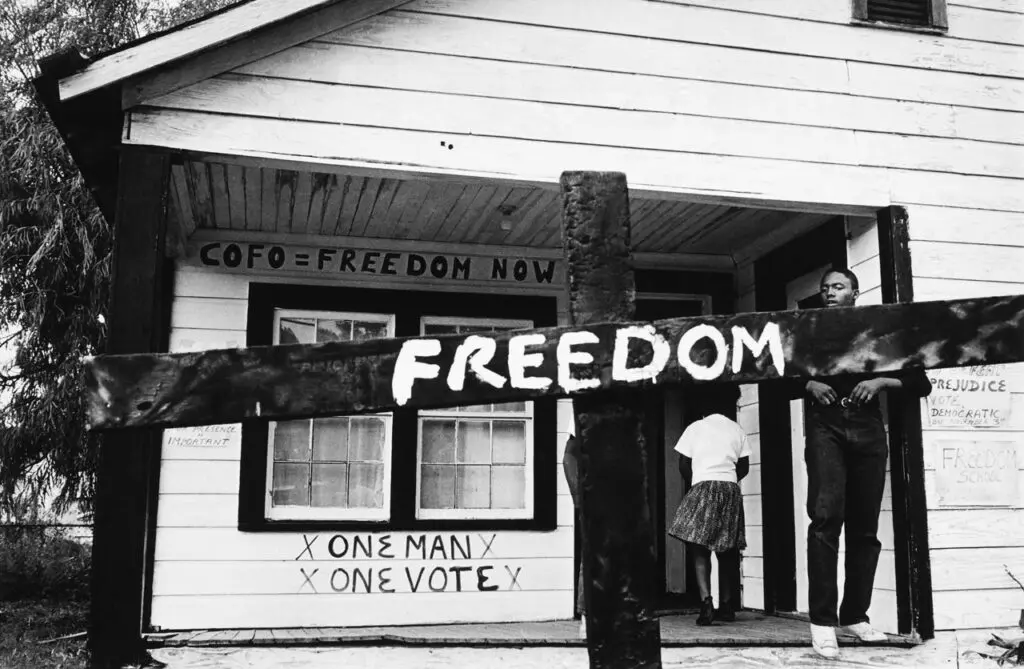
This photo is of a cross that was burnt on a lawn, repurposed by activists. They wrote “freedom” on it and placed it in front of a Freedom School, where people could learn about Black history, racism, and the rights of citizens—and the importance of voting. Seeing these images really made me reflect on the past and what is happening today in the United States. The importance of who we vote into power does make a big difference in people’s lives. We can never take our freedom for granted, and there is power in community pulling together. Wakayama was born on April 3, 1941, and raised in New Westminster, British Columbia. He was one of the 23,000 Japanese Canadians impacted by the Canadian government’s forced removal, incarceration, and dispossession of a population purely based on their race. He died on March 23, 2018. His work is at the Vancouver Art Gallery until February 22, then it will be going to Stanford University’s permanent collection. So check it out while you still can. I highly recommend it.
